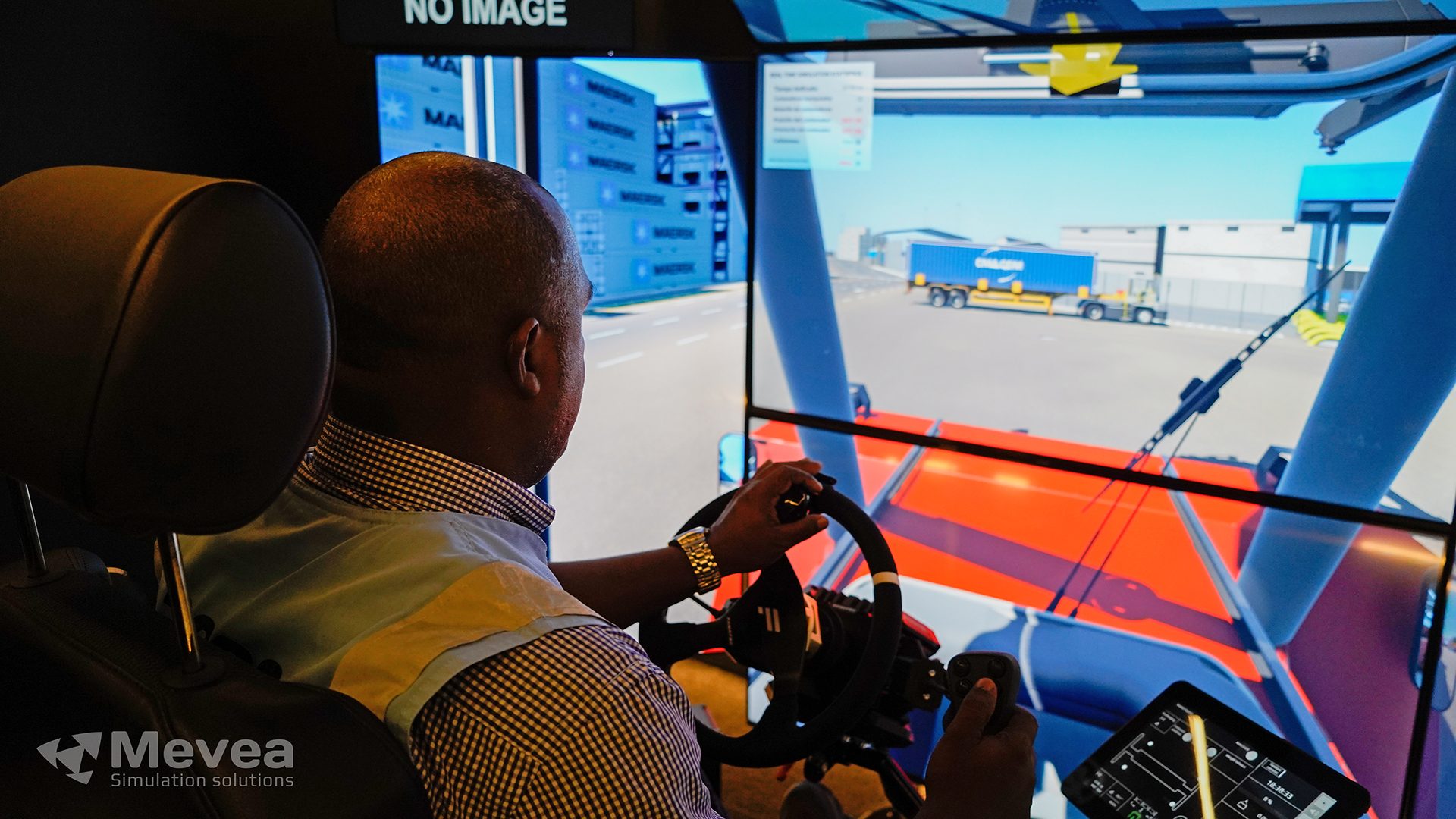
In crane operator training, you should measure three core dimensions: safety performance, work quality, and productivity. These three together give a complete picture of operator competency. Measuring only speed or throughput misses critical factors that determine whether an operator is genuinely ready to work on live equipment.
The key insight is that high productivity accompanied by poor safety or sloppy technique is not good performance. A balanced training assessment holds all three dimensions together, so that operators who advance through a program have genuinely earned that progress. The sections below unpack each dimension and explain how to turn them into actionable training metrics.
The insights in this article are drawn from the on-demand Mevea webinar How Port Operators Are Trained with Simulators, which features a real customer case from Terminal Portuario de Guayaquil (TPG), part of Hanseatic Global Terminals (HGT), including insights from the Technical Manager at TPG. The webinar covers how simulator-based training helps modern container terminals improve operator readiness, reduce costs, and avoid operational disruptions. Watch the on-demand webinar replay here.
What Metrics Actually Reveal Crane Operator Competency?
Crane operator competency is accurately revealed by a combined score across safety, quality, and productivity. No single metric tells the full story. An operator who moves containers quickly but with erratic load swings or near-miss incidents is not competent. True competency means performing well across all three dimensions consistently and under varied conditions.
Beyond the overall composite score, granular data points add important depth. These include:
- Lifting path accuracy – how closely the operator follows an optimal load path
- Joystick movement patterns – smoothness, precision, and unnecessary corrections
- Mistakes recorded per exercise – categorized by type and severity
- Performance across different conditions – varying weather, load types, and scenario difficulty
These data points transform a training session from a pass/fail exercise into a detailed diagnostic. They reveal not just whether an operator succeeded, but how and why, giving instructors the information they need to target specific weaknesses.
How Is Safety Performance Measured During Crane Operator Training?
Safety performance in crane operator training is measured by tracking incidents, near-misses, and unsafe behaviors that occur during simulated exercises. This includes load collisions, exceeding safe working limits, improper sequencing of operations, and any action that would constitute a safety violation on real equipment.
Simulator-based crane safety training has a significant advantage here: every unsafe event is captured automatically without any real-world consequence. Instructors can review exactly when and why a safety breach occurred, replay the sequence, and use it as a direct teaching moment. Over multiple sessions, the frequency and severity of safety incidents should trend downward as a measurable indicator of progress.
Safety scoring should also account for consistency. An operator who performs safely in straightforward scenarios but makes poor decisions under pressure or in adverse weather conditions has not yet reached full competency. Training programs should therefore expose operators to challenging scenarios and measure safety performance across all of them, not just the baseline exercises.
What Quality Indicators Should Crane Training Programs Track?
Quality indicators in crane training programs focus on the precision and technique of each operation rather than how fast it is completed. Key quality metrics include load swing control, accuracy of container placement, smoothness of joystick inputs, and adherence to correct lifting paths.
Load swing is one of the most telling quality indicators. Excessive swing during a lift signals poor joystick control and increases cycle time, wear on equipment, and risk to surrounding personnel and cargo. Tracking the amplitude and duration of load swing across exercises gives a clear picture of how an operator’s technique is developing.
Placement accuracy is equally important, particularly for STS and RTG crane operations where containers must land precisely on target positions. Training systems can log the deviation between intended and actual placement for every move, producing a quality score that reflects real operational standards. When this data is tracked over time, instructors can see whether precision is improving, plateauing, or degrading under more complex scenarios.
How Do You Measure Productivity Gains from Crane Operator Training?
Productivity gains from crane operator training are measured by tracking moves per hour, cycle times, and task completion rates across training sessions. These figures should be compared against baseline measurements taken at the start of training to quantify improvement over time.
However, productivity metrics must always be interpreted alongside safety and quality scores. An operator who increases their moves-per-hour figure by cutting corners on load control or placement accuracy has not made a genuine productivity gain. The goal is to improve throughput while maintaining or improving performance on the other two dimensions.
In simulator training, productivity data is captured automatically for every session. This allows instructors to identify whether an operator is genuinely becoming more efficient or simply rushing. It also helps set realistic benchmarks, since simulator data can be compared against known performance standards for experienced operators, giving trainees a clear target to work toward.
Which Training Metrics Matter Most for Port Terminal Operators?
For port terminal operators, the metrics that matter most are those directly tied to operational impact: safety incident rates, container placement accuracy, and moves per hour. These three translate directly into terminal performance, liability exposure, and cargo damage rates, making them the most commercially significant training KPIs.
Port environments add specific complexity that shapes which metrics carry the most weight. STS crane operators, for example, work under strict vessel turnaround pressures, so cycle time and productivity metrics are closely scrutinized. RTG and RMG operators in the yard face dense stacking environments where placement accuracy is critical to avoid cascading delays. Reach stacker and straddle carrier operators need strong situational awareness metrics, since they operate in areas with high pedestrian and vehicle traffic.
Our port equipment training simulators are designed to capture exactly these operational metrics across all major equipment types, including STS cranes, RTG cranes, and reach stackers, providing the data terminal operators need to make informed decisions about operator readiness.
How Does an Instructor Station Help Track and Evaluate Trainee Progress?
An instructor station helps track and evaluate trainee progress by providing real-time visibility into every aspect of a training session, along with recorded data that can be reviewed after each exercise. Instructors can monitor safety events, movement patterns, and performance scores as they happen, and intervene or adjust scenarios on the fly.
The value of a dedicated instructor interface goes well beyond observation. After each session, the station generates detailed performance reports covering safety, quality, and productivity scores alongside the granular data points such as lifting paths, joystick movements, and logged mistakes. This turns every training session into a structured feedback opportunity rather than an informal practice run.
Over multiple sessions, the instructor station builds a performance history for each trainee. This longitudinal view is essential for identifying persistent weaknesses, confirming that improvements are genuine rather than situational, and making defensible decisions about when an operator is ready to move to live equipment. It also supports structured debriefs, where instructors can replay specific moments from a session to show the trainee exactly what happened and why it matters.
To see these principles in action with a real-world example, watch the on-demand replay of the Mevea webinar How Port Operators Are Trained with Simulators. The webinar features a customer case from Terminal Portuario de Guayaquil (TPG), part of Hanseatic Global Terminals (HGT), and explores how simulator-based training delivers measurable improvements in safety, productivity, and workforce readiness at a working container terminal. Watch the webinar replay now.
This content was generated with the help of AI and it may contain mistakes