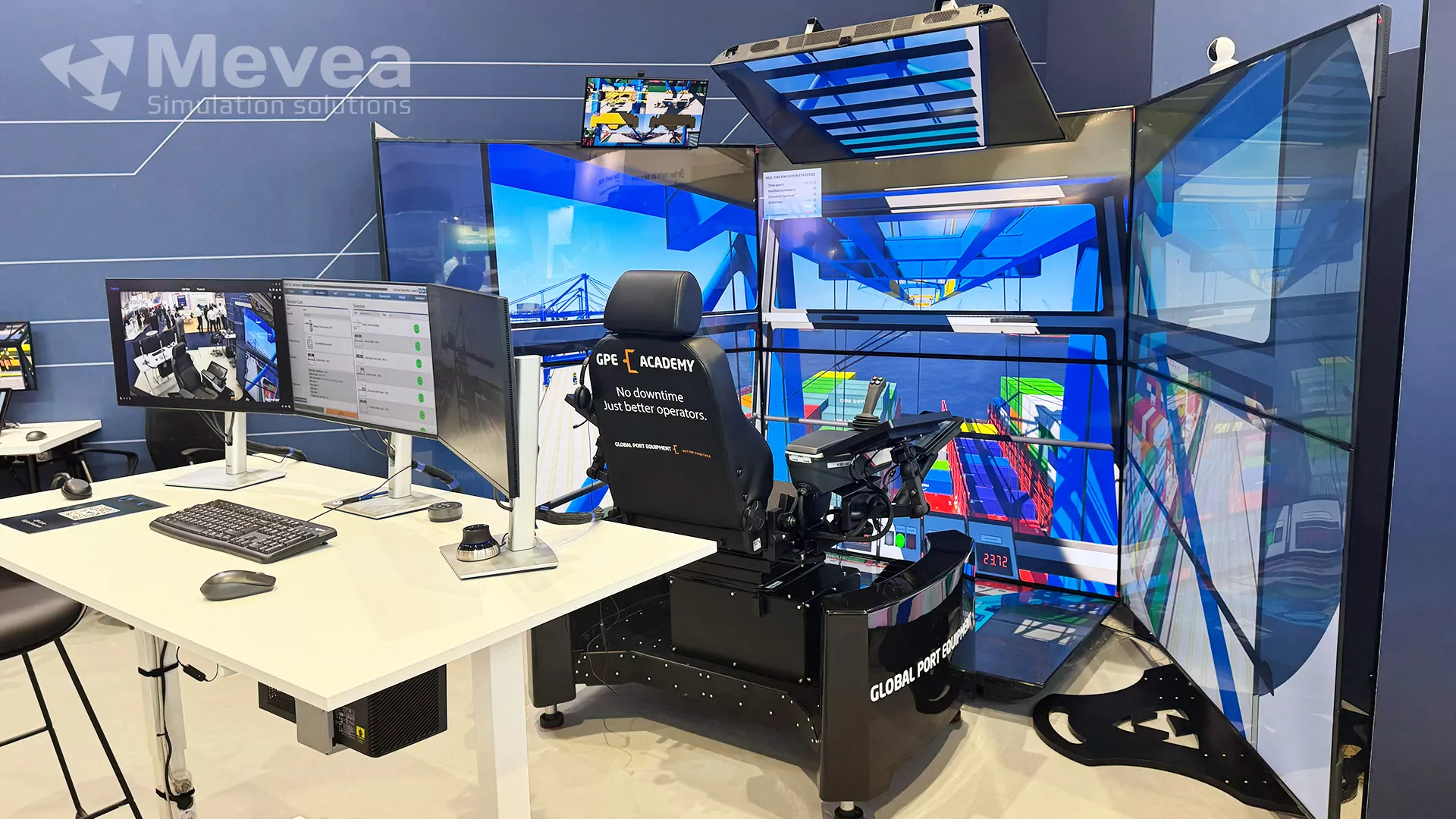
Yes, ports should invest in simulator training before or alongside terminal capacity expansion — not after. Bringing in new equipment or expanding berth capacity without a trained workforce in place creates immediate bottlenecks that undermine the entire investment. For port operators planning growth in 2026, simulator training is not a supplementary cost; it is a prerequisite for realizing the productivity gains that justify expansion in the first place. The questions below unpack exactly why that sequencing matters and what it looks like in practice.
What happens to terminal efficiency when operators aren’t fully trained before expansion?
Terminal efficiency drops sharply when operators are learning on the job during an expansion phase. Untrained or undertrained operators work more slowly, make more positioning errors, and require more supervision — all of which reduce moves-per-hour rates precisely when throughput targets are at their highest. The productivity gap between a trained and an untrained crane operator can be significant enough to offset the capacity gains that the expansion was designed to deliver.
The problem compounds quickly. In a container terminal, every delayed move affects the vessel schedule behind it. Slower cycle times on a new Ship-to-Shore crane, for example, create downstream congestion in the yard, which then slows reach stackers and internal transfer vehicles. The entire terminal operates as a system, and a weak link at any point in the chain degrades overall port efficiency. Investing in infrastructure without investing equally in operator readiness means the terminal runs below its designed capacity from day one.
There is also a safety dimension. Operators who are unfamiliar with new or upgraded equipment in a live, high-pressure environment are more likely to cause incidents. Incidents mean downtime, damage to cargo or equipment, and potential injury — none of which are acceptable outcomes during a period when the terminal is under pressure to perform.
How does simulator training reduce the risk of costly port expansions?
Simulator training reduces the risk of costly port expansions by ensuring that operators are competent and confident before they ever touch the real equipment. Rather than learning through trial and error on live cranes or vehicles, operators build their skills in a controlled environment where mistakes have no operational or financial consequences. This means the transition from expansion completion to full productive capacity is far shorter.
From a port investment strategy perspective, simulator training acts as a form of risk mitigation. The capital committed to new berths, cranes, or yard equipment only generates returns when those assets are being used productively. Every week an operator spends getting up to speed on real equipment is a week of underperformance on an asset that may have cost millions. Simulator-trained operators arrive at the machine already familiar with its controls, its physics, and its failure modes.
There is also a cost-avoidance argument. Training on real equipment consumes fuel, accelerates wear, and ties up machinery that could otherwise be handling cargo. Simulator training eliminates those costs entirely while delivering comparable — and in some dimensions superior — learning outcomes, because instructors can repeat specific scenarios, introduce difficult weather or load conditions, and pause the session to debrief in ways that are simply not possible in live operations.
What types of port equipment can operators train on with simulators?
Modern container terminal simulators cover the full range of port equipment used in both ship-side and yard operations. Operators can train on Ship-to-Shore (STS) cranes, Rubber Tyred Gantry (RTG) cranes, Rail Mounted Gantry (RMG) cranes, Mobile Harbour Cranes (MHC), reach stackers, empty container handlers, straddle carriers, terminal tractors, and forklifts. Offshore crane operations are also supported.
Heavy equipment training simulators from Mevea are available across all of these equipment categories, with each simulator built on physics-based technology that accurately replicates the mechanical behaviour, hydraulics, and load dynamics of the real machine. This means the muscle memory and spatial awareness an operator develops in the simulator transfers directly to the live equipment.
Training scenarios go beyond basic operation. Instructors can configure sessions to include varying weather conditions such as wind and rain, different cargo types and weights, equipment faults, and time-pressured loading and unloading sequences. This breadth of scenario coverage means operators are prepared not just for routine operations but for the edge cases that most frequently cause incidents or delays in a real terminal.
How long does it take to train a port operator using a simulator?
The time required to train a port operator using a simulator depends on the equipment type, the operator’s prior experience, and the performance standard required. For experienced operators transitioning to new equipment, simulator-based familiarisation can take as little as a few days. For operators new to a specific machine type, structured training programs typically run from one to several weeks before the operator is ready for supervised live operation.
The key advantage of simulator training is not necessarily speed — it is consistency and measurability. Every trainee goes through the same scenarios under the same conditions, and instructors can track performance metrics objectively through the training software. This makes it possible to identify which operators are ready to move to the real machine and which need additional practice, removing the guesswork that comes with purely on-the-job training.
For terminals expanding capacity and onboarding multiple operators simultaneously, simulators also solve a scheduling problem. Rather than queuing operators for time on a single piece of real equipment, multiple trainees can progress through their programs in parallel using simulator hardware, compressing the overall time from hiring to full productivity.
Should simulator investment come before or alongside terminal expansion budgets?
Simulator investment should be planned and budgeted at the same time as terminal expansion, with training programs beginning before the new equipment arrives. The practical reason is lead time: operators need weeks or months to reach competency, and that training can happen on simulators long before the physical infrastructure is complete. Treating simulator investment as a separate, later-stage decision means the terminal opens with a workforce that is not yet ready.
From a financial planning perspective, the return on simulator investment is directly tied to how quickly the expanded terminal reaches its target throughput. A terminal that achieves full productive capacity two months earlier than it would have with on-the-job training alone generates meaningful additional revenue. Set against the cost of Mevea simulator solutions and training program development, the payback period is typically short relative to the overall expansion budget.
There is also a strategic argument for treating terminal operator training as a capital investment rather than a training expense. Ports that build structured, simulator-based competency development into their operations create a durable advantage: faster onboarding of future hires, lower incident rates, and a measurable performance baseline that supports continuous improvement. As terminal automation and remote operation become more prevalent in 2026 and beyond, the ports that have already built simulator training into their training culture will be better positioned to adopt those technologies without disruption.
Ready to build a workforce that’s prepared for expansion from day one?
If your port is planning capacity growth and you want to ensure your operators are ready before the first new crane goes live, the Mevea sales team is here to help. Whether you are evaluating simulator options for a single equipment type or designing a comprehensive training program across your entire terminal, we can advise on the right solution for your operational scale, timeline, and budget. Contact the Mevea sales team today to discuss how simulator training can be integrated into your expansion plan from the outset.
This content was generated with the help of AI and it may contain mistakes