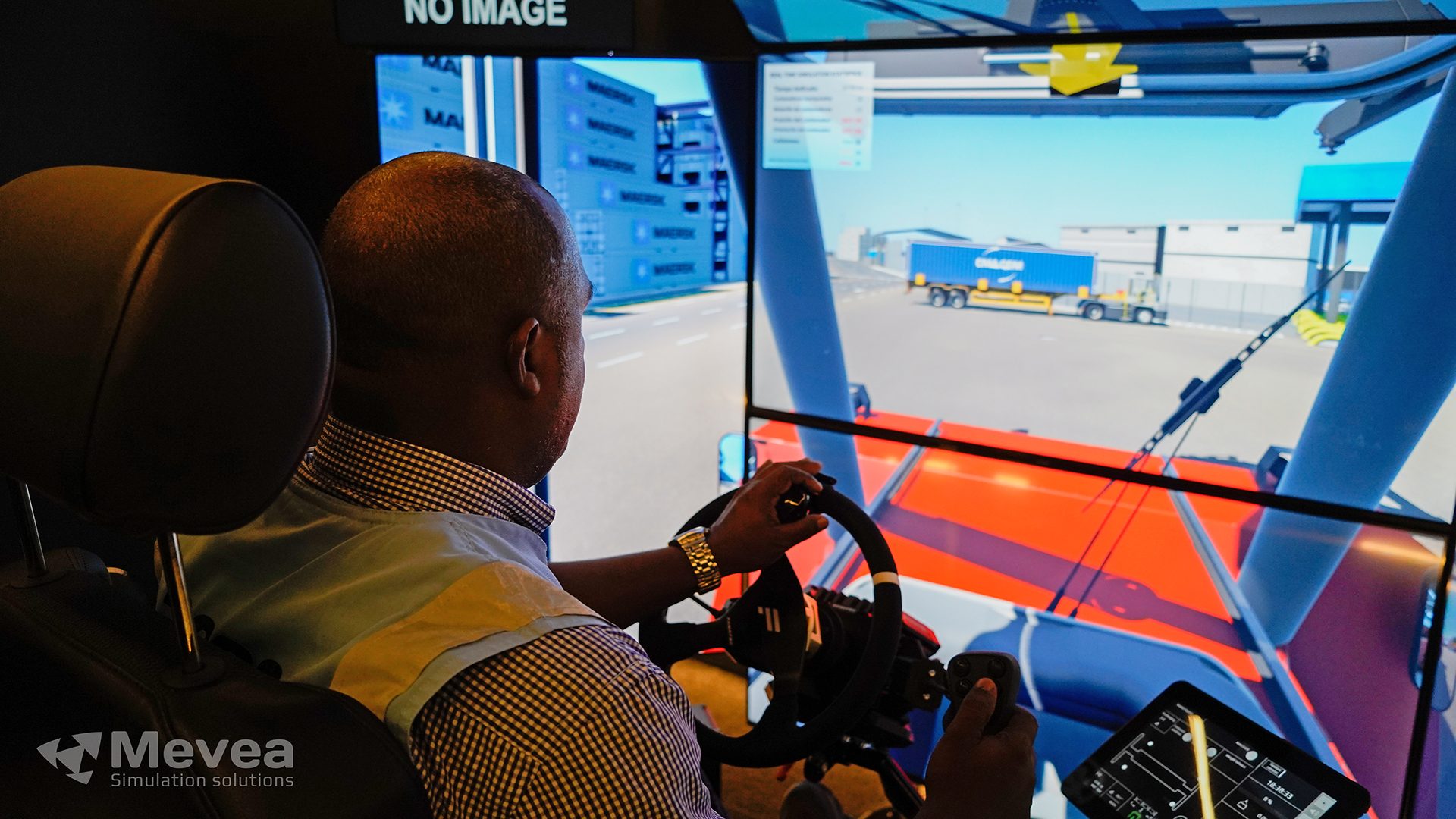
Training port operators on simulators instead of real equipment is the smarter choice for most terminals because it removes the need to take productive cranes and handling equipment out of service for routine training. Simulator training delivers the same skill development in a controlled, repeatable environment without the safety risks, fuel costs, or operational disruption that come with using live machinery. The questions below unpack exactly why that matters and how it works in practice — drawing on insights from the Mevea webinar How Port Operators Are Trained with Simulators, which features a real customer case from Terminal Portuario de Guayaquil (TPG), part of Hanseatic Global Terminals (HGT).
What Are the Biggest Risks of Training on Real Port Equipment?
Training on real port equipment exposes operators, colleagues, and cargo to genuine physical danger. Cranes handling loads of dozens of tonnes, straddle carriers moving through busy terminal lanes, and reach stackers operating near stacked containers all create high-consequence environments where a trainee’s mistake can cause serious injury, equipment damage, or cargo loss. These are not controlled learning conditions.
Beyond personal safety, there is significant operational risk. A trainee who misjudges a spreader alignment on a ship-to-shore crane can damage the crane structure, a vessel’s hatch cover, or the container itself. Repair costs and downtime can far exceed the cost of any training programme. Terminals also carry liability exposure when inexperienced operators are placed on live equipment in active operational zones.
There is a subtler risk too: the pressure of a live environment actively works against learning. A new operator who knows that a mistake has real consequences tends to be more hesitant, less willing to test techniques, and slower to build genuine confidence. Training under stress produces operators who know how to avoid mistakes but not necessarily how to handle the full range of situations they will encounter on the job.
How Does Simulator Training Actually Improve Operator Skill?
Simulator training improves operator skill by allowing deliberate, repeated practice across a wide range of scenarios in a consequence-free environment. Operators can attempt difficult lifts, navigate adverse weather conditions, and recover from equipment faults as many times as needed until the correct technique becomes instinctive. This kind of repetition is simply not possible on a live crane during a working shift.
The quality of the simulation matters enormously here. Physics-based simulators that accurately model crane mechanics, hydraulics, load dynamics, and environmental conditions produce operators who transfer their skills directly to real equipment from day one. When the simulator behaves like the actual machine, the muscle memory and decision-making habits built in training carry over reliably.
Structured feedback is another critical factor. Our simulator platforms include an Instructor Station that lets trainers monitor performance in real time, replay specific moments, and provide precise, evidence-based feedback after each session. This turns every training run into a coaching opportunity, accelerating skill development far beyond what is achievable through observation alone on real equipment.
How Much Does Simulator Training Cost Compared to Real Equipment Training?
Simulator training has a higher upfront investment but is significantly less expensive over time than training on real equipment. The ongoing costs of real-equipment training include fuel consumption, accelerated wear and tear, the opportunity cost of removing a productive crane from operation, and the financial exposure from training-related incidents. These costs accumulate with every training session across every operator cohort.
The opportunity cost alone is substantial in high-utilisation terminals. As Christian Etcheverry, Technical Manager at TPG, explained in the Mevea webinar How Port Operators Are Trained with Simulators: “We have a high use of our equipment. So to put, for example, a ship-to-shore or RTG to do training is for us a huge impact.” When a crane is generating revenue handling containers, every hour it spends as a training aid has a measurable cost.
A dedicated port equipment simulator removes that trade-off entirely. Real cranes stay in production. Training runs in parallel. The terminal optimises both throughput and operator development simultaneously rather than choosing between them.
What Types of Port Equipment Can Be Trained on a Simulator?
Modern port equipment simulators cover the full range of terminal machinery, including ship-to-shore (STS) cranes, Rubber Tyred Gantry (RTG) cranes, Rail Mounted Gantry (RMG) cranes, Mobile Harbour Cranes (MHC), offshore cranes, reach stackers, empty container handlers, straddle carriers, forklifts, and terminal tractors. Virtually every piece of equipment an operator will encounter in a container or bulk terminal can be simulated.
We offer training simulators across all of these equipment categories, with each simulator built on the same physics engine that accurately models the specific mechanical behaviour of that machine type. This means an RTG simulator does not simply look like an RTG, it responds like one, including the dynamics of load swing, trolley travel, and gantry movement under different load and wind conditions.
Hardware options scale to match the training objective. A desktop simulator suits classroom induction training. A professional platform with a motion system and multiple screens delivers an immersive, realistic experience for building advanced technique. A full-scale cab replica provides maximum fidelity for final-stage preparation before an operator steps onto a real machine for the first time.
When Should Port Terminals Use Simulators Versus On-the-Job Training?
Port terminals should use simulators for initial operator training, recurrent competency checks, scenario-based safety drills, and any training that would otherwise require removing productive equipment from service. On-the-job training remains valuable for familiarisation with a specific terminal’s layout, local procedures, and the precise feel of a particular machine, but it should follow simulator training rather than replace it.
The most effective approach treats simulator and on-the-job training as sequential rather than competing. Operators build their foundational skills, practice emergency responses, and reach a defined competency level in the simulator first. They then transition to real equipment already capable of safe, productive operation, which shortens the supervised on-the-job phase considerably and reduces the burden on experienced operators acting as mentors.
For terminals with structured training programmes, simulators also solve a scheduling problem that real-equipment training cannot. As Etcheverry noted at TPG in the webinar, organising training sessions and maintaining a coherent training plan was very complicated before simulator-based training was introduced. A dedicated simulator creates a predictable, bookable training resource that does not compete with production scheduling, making it far easier to run consistent programmes across large operator teams.
The practical answer is straightforward: use simulators as the primary training environment and reserve on-the-job time for the final familiarisation steps that only the real machine can provide.
Watch the Webinar: How Port Operators Are Trained with Simulators
The insights in this article are drawn from the Mevea webinar How Port Operators Are Trained with Simulators, featuring a real customer case from Terminal Portuario de Guayaquil (TPG), part of Hanseatic Global Terminals (HGT), including first-hand perspectives from the Technical Manager at TPG. The webinar covers how simulator-based training helps modern container terminals improve operator safety and productivity while reducing costs and avoiding operational disruptions.
The on-demand replay is now available. Watch the Mevea webinar replay here to see how HGT and TPG are using simulator training in practice and what it could mean for your terminal operations.
This content was generated with the help of AI and it may contain mistakes